How Much Do Owner-Operators Really Make? Gross vs Take-Home Pay
A $288,000 year can still pay you less than a company job. Here is the real math on owner-operator pay, line by line, from gross to what lands in your pocket.
Ask ten owner-operators what they make and you will get ten answers, and most of them will be the gross. "I grossed $6,000 last week" sounds great at the truck stop. It is also the least useful number in trucking, because the truck takes its cut before you do.
So let's do this properly. Below is one realistic year for a solo owner-operator running dry van, line by line, from the money the loads pay to the money that actually lands in your account. Swap in your own numbers as you go. That's the whole point.
Gross is not pay
Gross revenue is every dollar your loads pay: linehaul, fuel surcharge, detention, accessorials. It pays for the truck, the fuel, the insurance and the repairs first. You get what is left.
That is why two drivers grossing the same $280,000 can take home $60,000 and $110,000. The difference is almost never the rate. It is fuel, deadhead, the truck note and how much the shop got.
One owner-operator's year, line by line
Here is the example. These are round, believable numbers, not an average for the whole industry:
- 120,000 total miles a year (2,500 a week, 48 weeks worked)
- $2.40 gross rate per mile, counted on all miles including deadhead
- 6.5 mpg, diesel at $3.75 a gallon
- A $2,400 a month truck payment
- Factoring at 3%, no dispatcher
| Line | For the year |
|---|---|
| Gross revenue (120,000 mi × $2.40) | $288,000 |
| Fuel (18,462 gal × $3.75) | −$69,231 |
| Maintenance and repairs ($0.18/mi set aside) | −$21,600 |
| Tires ($0.04/mi) | −$4,800 |
| Truck payment ($2,400 × 12) | −$28,800 |
| Insurance ($1,200 × 12) | −$14,400 |
| Factoring (3% of gross) | −$8,640 |
| Tolls, scales, parking | −$3,600 |
| Plates, permits, ELD, phone, bookkeeping | −$6,000 |
| Total costs | −$157,071 |
| Profit before tax | $130,929 |
Two things jump out. Fuel is the biggest line by far, bigger than the truck. And the truck payment and insurance ($43,200 between them) do not stop when you take two weeks off at Christmas. Fixed costs are charged for 52 weeks even if you only roll for 48.
For comparison, the American Transportation Research Institute put the average cost of running a truck at a record $2.336 a mile in 2025. That figure includes a driver's wages and benefits, which is the part an owner-operator pays themselves out of profit. Our example's costs come to about $1.31 a mile before paying the driver, which lines up.
Then the taxes
The $130,929 is not yours yet either. As a self-employed driver you pay both halves of Social Security and Medicare (self-employment tax, about 15.3% on most of your profit) plus federal and state income tax. You also pay it quarterly, not once a year, or the IRS adds penalties.
A common rule of thumb is to set aside 25% to 30% of profit for taxes. Your real rate depends on your state, your deductions, per diem and whether you run as an LLC or S-corp, so talk to a tax preparer who works with truckers. At 28%, our driver sets aside about $36,660.
Take-home: roughly $94,000 for the year. About $1,960 a week across 48 working weeks.
The number nobody wants to do: pay per hour
Running 2,500 miles a week usually means 60 to 70 hours on duty once you count loading, fueling, waiting and paperwork. Call it 65 hours across 48 weeks: 3,120 hours.
$94,000 ÷ 3,120 hours = about $30 an hour.
That is a decent living. It is also a reminder that a company job paying $75,000 with health insurance and no truck note is not as far behind as the gross makes it look. If you are thinking about going independent, run this math with your own lane and your own truck before you sign anything.
What moves take-home the most
Small changes on the biggest lines beat big changes on the small ones. In the example above:
- Rate per mile. Ten cents more on every mile is $12,000 a year. That is the whole insurance bill. Know your floor before you call a broker: what a good rate per mile looks like in 2026.
- Deadhead. Rate counted on loaded miles only hides empty miles. 300 miles out to a load at $0 is $0 revenue and about $173 of fuel. Here is how to cut deadhead.
- Fuel. Going from 6.5 to 7 mpg saves about 1,300 gallons, or $4,900 a year, with no new freight at all.
- Fees. A 10% dispatcher on $288,000 is $28,800, which drops take-home to about $73,000 after tax. Sometimes it is worth it. Know the number either way: dispatcher, factoring and driver fees explained.
- Getting paid for your time. Two hours of detention at $50 an hour on three loads a week is $14,400 a year that a lot of drivers never bill. See how to bill detention pay.
Check every load, not just the year
A year is made of loads, and the year goes wrong one bad load at a time. Before you say yes, take the rate and subtract fuel for all the miles, the dispatcher's cut and the factoring fee. What's left is what that load is really worth to you.
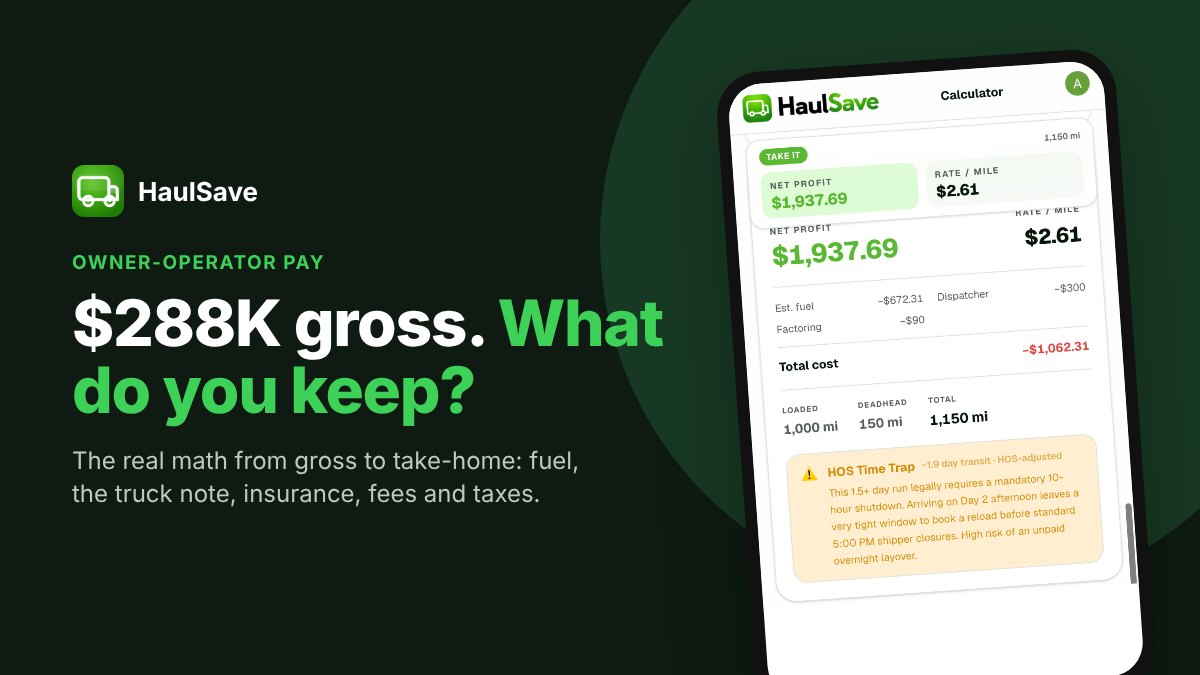
Here is a real example from the HaulSave calculator: a $3,000 load, 1,000 loaded miles plus 150 deadhead. Fuel comes to $672.31, the dispatcher $300, factoring $90. Net on that load: $1,937.69, at $2.61 a mile on 1,150 total miles. Your fixed costs (the truck note, insurance) still have to come out of that, which is why the per-load number needs to clear a bar, not just be positive. We go through that bar in how to tell if a load is profitable.
The short version
- Gross is what the loads pay. Take-home is what is left after fuel, the truck, insurance, repairs, fees and taxes.
- In our example, $288,000 gross became about $131,000 profit and about $94,000 take-home.
- That works out to around $30 an hour at 65 hours a week.
- Rate per mile on all miles, deadhead, fuel and fees move take-home more than anything else.
The numbers in this post are an example to show the math, not a promise of earnings or tax advice. Your costs, lanes and taxes will be different.
HaulSave does this math on every load before you book it: fuel for every mile, deadhead, dispatcher and factoring fees, and what's left. Try the free rate per mile calculator or start free. The free plan saves 5 loads, no card needed.
Want to see your real per-mile profit on every load?
HaulSave tracks rate, fuel, fees, and expenses so you know your true take-home before you say yes to a load.
Get started free